
The Costs of Buying a Home: The 10% Nobody Tells You About
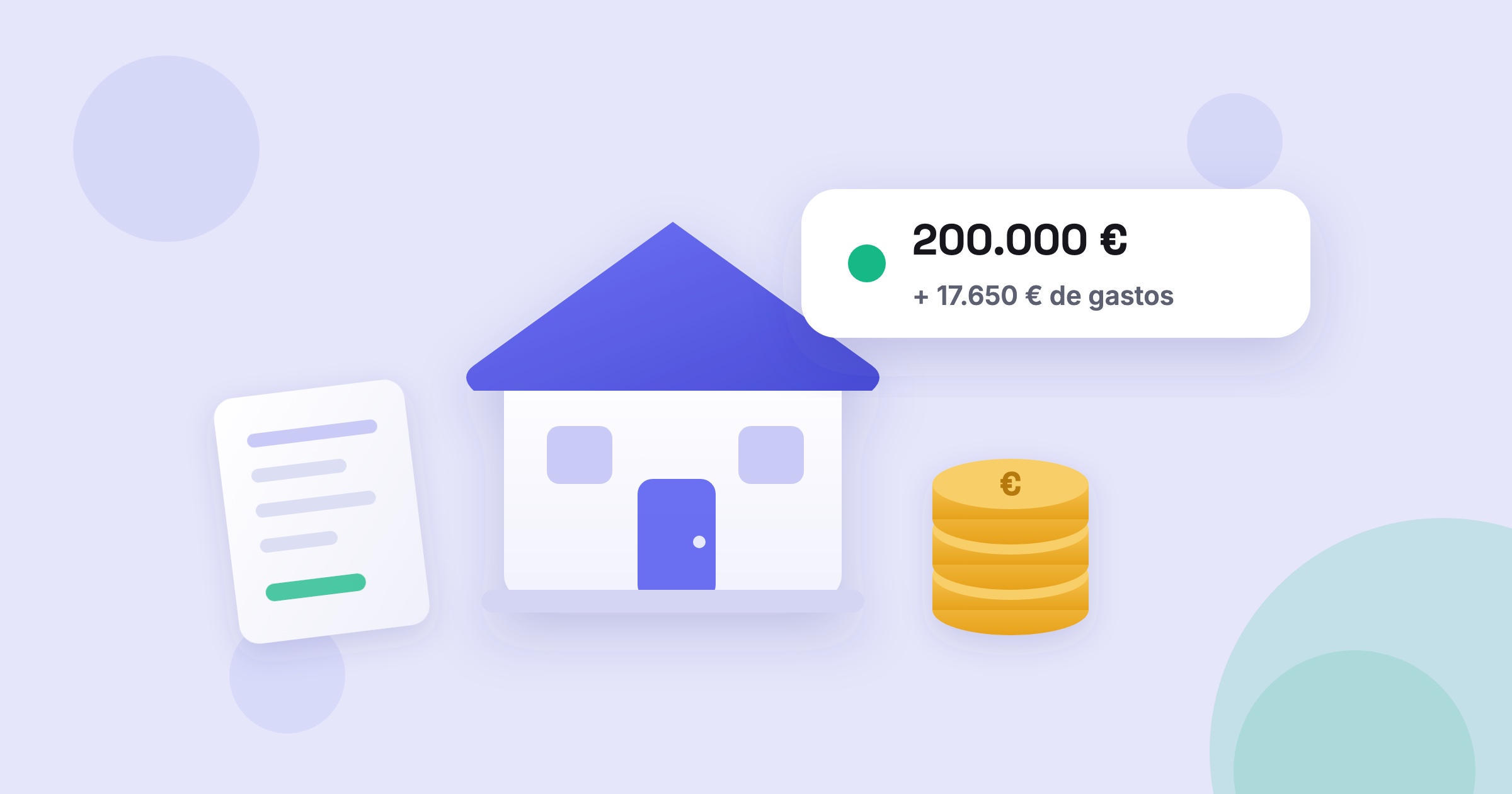
You find the flat, you see the price and you work out the deposit. And then someone drops the line: "don't forget the costs." Buying a home costs considerably more than its price: an extra 10% to 12% in taxes and paperwork, paid in cash, not with the mortgage. On a €200,000 property that's €20,000 to €24,000 on top. Here is the full list, with numbers.
Why the costs aren't in the mortgage
This is the part that catches almost everyone out. The bank lends you at most 80% of the property's valuation, and it finances the purchase, not the taxes. So you need two separate pots of money:
- The deposit: the 20% the bank doesn't put in.
- The costs: another 10-12% that goes on taxes, notary, registry and paperwork, and comes entirely out of your account.
That's where the 30% rule of thumb comes from: for a €200,000 home you need around €60,000 before you sign anything. If you're still at the stage of working out whether you can afford it, we cover that in detail in how much you need to earn to buy a flat in Spain.
The tax: the biggest cost, by far
Between 70% and 80% of all the costs is a single item: the tax. And which one you pay comes down to one thing — whether the property is new or second-hand.
Second-hand property: ITP
You pay Impuesto de Transmisiones Patrimoniales (property transfer tax). It's the cost that varies most from one part of Spain to another, because its administration is devolved to the regions: each one sets its own rate. In practice it runs between 6% and 10% depending on where you buy. On €200,000, the gap between one region and another is €8,000 for the same house.
Before you do any sums, look up the rate in your region and whether you qualify for a reduction: nearly all of them have lower rates for people under 32-35, large families, people with a disability, or a main home below a certain price. They're usually worth several thousand euros, and you have to ask for them.
New-build: VAT + stamp duty
If you buy directly from the developer you pay 10% VAT, the same across Spain (except the Canaries, which have their own tax), plus stamp duty (Actos Jurídicos Documentados), set by each region and usually between 0.5% and 1.5%. All in, around 11% of the price.
The deadline to self-assess the tax is 30 working days from signing. Keep that money separate and available: it comes round fast.
Notary, registry and conveyancing: the paperwork
Here the figures are much smaller and fairly predictable:
- Notary: around €600-900 for an average home. The fees are set by law, so they don't vary much from one notary to another.
- Land Registry: around €400-600. This is what it costs to have the house recorded in your name, which is precisely what makes you the owner.
- Conveyancing (gestoría): around €400, optional in theory. If there's a mortgage, the bank picks it and pays for it.
- Valuation: €300 to €600. Only if you take a mortgage, and you pay it.
Add it up: the paperwork comes to €1,500-2,500. It's real, but it isn't what wrecks a budget. What wrecks a budget is the tax.
What the bank has paid since 2019
One distinction that saves a lot of confusion: separate the costs of buying the house from the costs of signing the mortgage. Since the 2019 mortgage law, on the mortgage the bank covers the conveyancing, the notary, the registry and the stamp duty on the loan; you only pay the valuation. You can check it in the mortgage guide on the Bank of Spain's Bank Customer Portal.
That does not cover the purchase costs, which remain entirely yours. And while you're looking at the mortgage, it's a good moment to negotiate its terms: there's more money at stake there than in this whole list.
A worked example: €200,000
A second-hand home at €200,000, an 80% mortgage, in a region with ITP at 8%:
| Item | Amount |
|---|---|
| Deposit (20%) | €40,000 |
| ITP (8%) | €16,000 |
| Notary | €750 |
| Registry | €500 |
| Valuation | €400 |
| Total costs | €17,650 |
| You need saved | €57,650 |
Almost €18,000 that isn't the house and that nobody finances. With ITP at 10% instead of 8% it would be €21,650. Which is why the first number to check isn't the price of the flat: it's your region's rate.
Four things to do before you sign
- Look up your region's ITP rate and check whether you fit any reduction by age, family or property price.
- Set the money for costs aside in a different account from the deposit. They're two separate payments, at different moments.
- Ask for the breakdown in writing from the estate agent or the notary before signing. It should match this list.
- Don't drain your buffer. The move, the furniture, setting up the utilities and the first repairs all arrive right afterwards. Keep your emergency fund intact: buying a home and leaving yourself at zero is the fastest way back to living paycheck to paycheck.
How Inveriok helps
The hard part of this sum isn't the arithmetic, it's knowing where you're starting from. In Inveriok you can see your real net worth — what you have minus what you owe — and set the deposit and the costs as a savings goal with a date, so you know the pace you're on. And with the mortgage calculator you can check whether the payment you'd be left with genuinely fits your numbers.
Frequently asked questions
How much do you need to have saved to buy a home in Spain?
The rule of thumb is 30% of the price: around 20% as a deposit, because banks rarely lend more than 80% of the valuation, plus 10-12% for costs and taxes. On a €200,000 property that's about €60,000 — and the costs have to be paid in cash: they don't go into the mortgage.
Which tax do you pay when buying a home, ITP or VAT?
It depends on whether the property is new or second-hand. Second-hand pays ITP (transfer tax), which is devolved to the regions and runs from roughly 6% to 10% depending on where you buy. New-build pays 10% VAT plus stamp duty (AJD), which usually sits between 0.5% and 1.5%.
Who pays the mortgage costs, the bank or me?
Since the 2019 mortgage law the bank covers the conveyancing, the notary, the land registry entry for the loan deed and the stamp duty on the mortgage. You pay the valuation. Careful, though: those are the mortgage costs, not the purchase costs, which are still entirely yours.
How long do you have to pay ITP after buying?
The general deadline to self-assess the tax is 30 working days from signing. It's one of the reasons to keep the money for costs separate and available: it comes round fast and it doesn't wait.
Sources
- Spanish Tax Agency — ITP and AJD — what the tax covers and the 30-working-day deadline to self-assess it.
- Spanish Tax Agency — administration of ITPAJD — the tax is devolved to the regions, which is why the rate changes depending on where you buy.
- Bank Customer Portal (Bank of Spain) — how mortgage costs are split between bank and customer.
- General Council of Notaries — notary fees and the conveyancing process.
- Association of Land Registrars — registering the property in the Land Registry.
- Rankia — costs and taxes when buying a home — ranges for notary, registry, conveyancing and valuation (2026).
- idealista — housing news — prices and the property market.
Disclaimer. This article is informational and uses average percentages and figures as an illustration; ITP and stamp duty are set by each region and your own case depends on where you buy, the type of property and your personal situation. Check the rate currently in force in your region. This is not financial or tax advice.