
How to Make a Budget That Actually Works
Almost everyone has tried to make a budget at some point. And almost everyone has abandoned it within two weeks. It's not lack of discipline: most budgets are built to fail — too detailed, too optimistic, impossible to keep up. A good budget isn't a perfect spreadsheet — it's one you're still using in March. Let's build that one.
Why most budgets fail
- Too much detail. Forty categories and a twelve-tab spreadsheet. It works for a week, then wears you out.
- Too optimistic. You put "entertainment: €50" when you know you spend €150. You blow through it by the first Friday and give up.
- No real data. You budget by guesswork, without ever having checked where your money actually went last month.
- Everything by hand. Logging every expense in a notebook or spreadsheet holds up… until one day you forget, and you never go back.
You're not alone: reaching the end of the month is hard
According to INE's Living Conditions Survey, in 2025 8.5% of the population reached the end of the month with "great difficulty", and many more with some difficulty. A budget doesn't print money, but it does one decisive thing: it gives you control over where what you have goes, instead of finding out once there's none left.
The 50/30/20 rule: the simplest budget that works
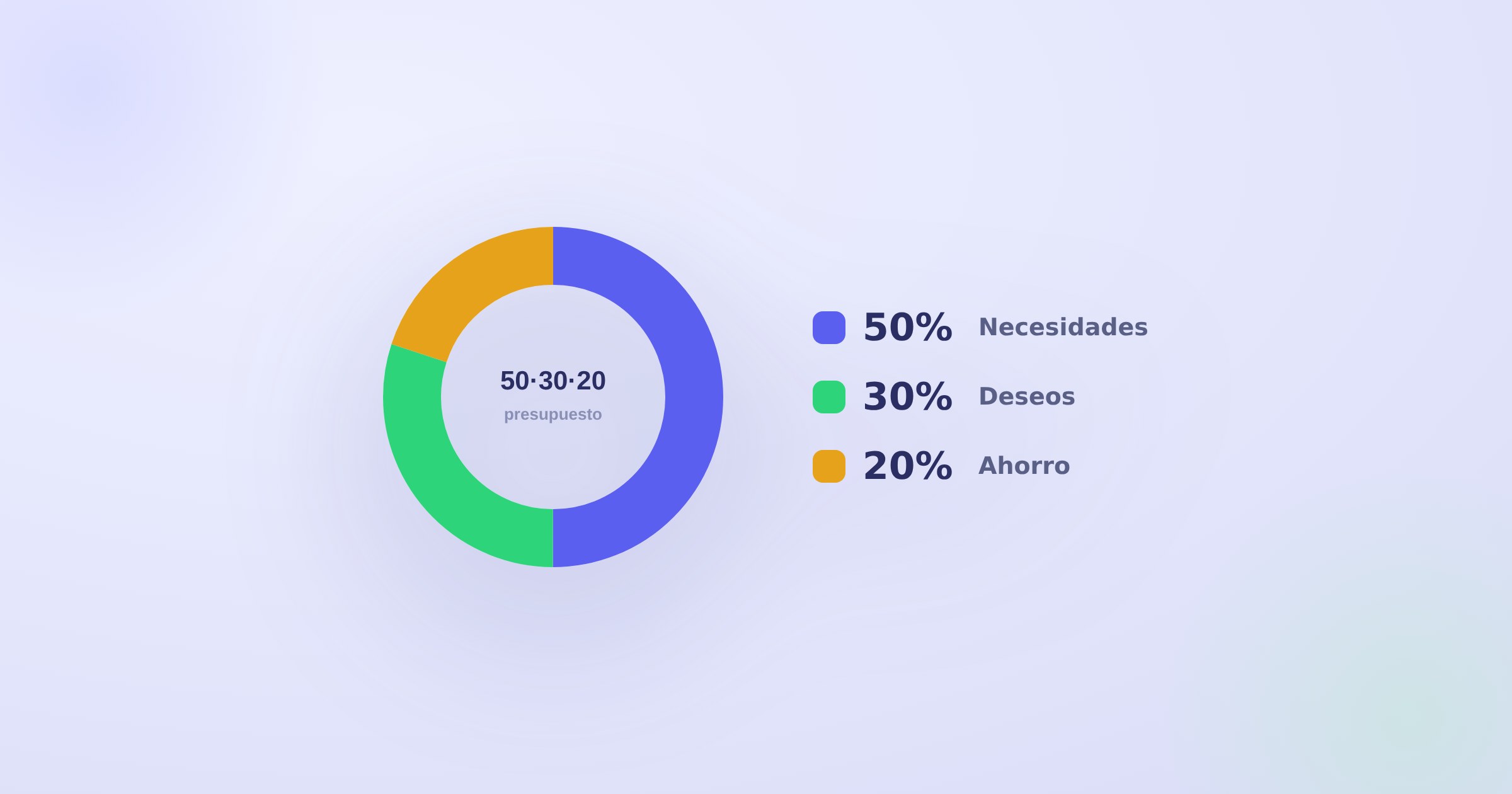
If you don't know where to start, start here. Split your net income into three blocks:
- 50% — Needs. What you can't avoid: housing, utilities, food, transport, insurance, minimum debt payments.
- 30% — Wants. What makes life pleasant: entertainment, eating out, subscriptions, treats, travel.
- 20% — Savings and debt. Your emergency fund, savings goals, investing, and paying down expensive debt.
These are guideline proportions, not a law. If rent eats 60% of your income, your split will look different. What matters is that every euro has a destination before you spend it.
How to do it, in 5 steps
1. Look at one real month first. Before budgeting anything, review your transactions from the last month. Budgeting without data is guessing; with data, it's adjusting.
2. Calculate your net income. What actually lands each month. If it's irregular, use the average of the last few months (and round down).
3. Split it into capped categories. Few and clear: housing, food, transport, entertainment, savings… with a cap on each. Less is more: 6-8 categories stick; 40 don't.
4. Automate the 20% savings. Have it go out on its own on payday, before you spend the rest — that's paying yourself first. What you don't see, you don't spend.
5. Review it once a week, for 5 minutes. Check how much you've spent in each category and adjust what's left of the month. This is where the budget stops being a piece of paper and starts actually changing your money.
The trick to not abandoning it
The budget that lasts isn't the most detailed one — it's the one that doesn't create work for you. If you have to log every coffee by hand, you'll quit. The key is that tracking is nearly automatic: you see in real time how much you've spent on "entertainment" without typing anything in. And watch out for small recurring expenses: they're what blows up a budget without you noticing.
Do it without wrestling a spreadsheet
In Inveriok you set a category limit and see how much you've spent in each one in real time, with an alert as you approach the cap — with nothing to log and no bank connection if you don't want one. The budget stops being a January resolution and starts running on its own.
Frequently asked questions
What is the 50/30/20 rule?
A simple method for splitting your net income: 50% to needs, 30% to wants, and 20% to savings and debt repayment. It's a guideline — adjust it to your situation, but keep the core idea that every euro has a destination.
How often should I review my budget?
A five-minute weekly review is enough to adjust what's left of the month. What matters is consistency, not detail: a simple budget you actually review beats a perfect one you abandon.
How do I budget with irregular income?
Use the average of the last few months and, if you can, budget off your "bad" month. On good months, put the extra toward savings or a buffer that covers the slow ones.
Why do I always end up abandoning my budget?
Usually for two reasons: too many categories, and tracking it by hand. Simplify to 6-8 categories and automate the tracking so you don't depend on logging every expense.
Sources
- Finanzas para Todos (CNMV and Bank of Spain) — free personal budgeting tools from Spain's national financial education plan.
- OCU — Money — independent reviews of accounts, fees and savings products.
- Bank Customer Portal (Bank of Spain) — your bank must send you a monthly statement with every transaction on the account.
- INE (Spanish National Statistics Institute) — Living Conditions Survey (ECV), 2025: 8.5% of the population reached the end of the month with great difficulty.
Disclaimer. This article is for informational and educational purposes only. It does not constitute personalised financial advice. For specific decisions, consult a professional registered with Spain's CNMV.